Books List
Showing of 1 results Of
-
1000
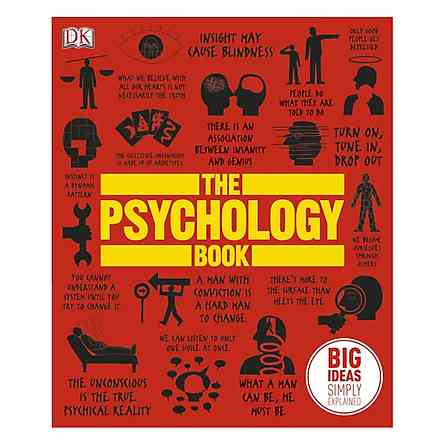
The Psychology Book (Series Big Ideas Simply Explained)
Publisher: A Dorling Kindersley BookAuthor: DKNot AvailableDescription
Translate description to VietnameseThe Psychology Book DK is your visual guide to the vivid and fascinating visual world of human behavior. Explore how we learn, become emotionally engaged with others, and develop coping mechanisms to deal with adversity, or how to integrate within a group.
Get to know key thinkers, from Freud and Jung to Elizabeth Loftus and Melanie Klein, and follow charting and timeline studies.
The Psychology Book by DK is filled with profiles of the work of psychologists and psychoanalysts. The book describes psychology as coming from the Greek “psyche” meaning “soul” or “mind.” “Logia” is a “study” or “account.” These definitions give an overall idea what psychology means.
Psychology developed from its roots of philosophy, through behaviorism, psychotherapy, and the study of the cognitive, social, and developmental psychology, to the psychology of difference. These many branches cover the whole spectrum of mental life and human and animal behavior. These areas have overlapped with many other disciplines. In many ways psychology has influenced decisions made in government, business, industry, advertising, and the mass media. It has given us ideas that have changed the way people think.
In 1879, Wilhelm Wundt founded the very first laboratory of experimental psychology at Leipzig University in Germany, and departments of psychology began springing up across Europe and the United States. The scientific method was applied to questions concerning perception, consciousness, memory, learning, and intelligence. These early practices produced a wealth of theories. “Behaviorists” designed experiments to observe THE behavior of animals in carefully monitored settings. Later these theories were used in human experiments.
The mid-20th century witnessed the cognitive revolution with advances in neuroscience. There was an evolution from Freudian psychology to cognitive therapy that led to new improvements in mental health treatments, and proved a model for the unconscious, human drives, and behavior. At the beginning of the 21st century cognitive psychology was still dominant with an effect on neuroscience, education, and economics. It has even influenced the nature-nurture debate in the light of recent discoveries in genetics and neuroscience.
With pithy explanations of different schools of psychology including psychotherapy, cognitive psychology, and behaviourism, this is an ideal reference whether you're a student, or a general reader. It's your authoritative guide to over 100 key ideas, theories, and conditions, including the collective unconscious, the "selfish" gene, false memory, psychiatric disorders, and autism.
If you're fascinated by the human mind, The Psychology Book is both an invaluable reference and illuminating read.
Cuốn sách Tâm lý học của nhà DK là hướng dẫn trực quan dành cho bạn về thế giới trực quan sinh động và hấp dẫn của hành vi con người. Khám phá cách chúng ta học hỏi, trở nên gắn kết cảm xúc với người khác và phát triển các cơ chế đối phó để đối phó với nghịch cảnh, hoặc cách hòa nhập trong một tập thể.
Làm quen với các nhà tư tưởng chủ chốt, từ Freud và Jung đến Elizabeth Loftus và Melanie Klein, và theo dõi các nghiên cứu biểu đồ và mốc thời gian.
Sách chứa đầy hồ sơ về công việc của các nhà tâm lý học và nhà phân tâm học. Cuốn sách mô tả tâm lý học xuất phát từ "tâm lý" Hy Lạp có nghĩa là "linh hồn" hoặc "tâm trí". "Logia" là một "nghiên cứu" hoặc "tài khoản". Những định nghĩa này đưa ra một ý tưởng tổng thể về ý nghĩa của tâm lý học.
Tâm lý học phát triển từ gốc rễ của triết học, thông qua chủ nghĩa hành vi, tâm lý trị liệu và nghiên cứu về tâm lý học nhận thức, xã hội và phát triển, đến tâm lý học khác biệt. Nhiều nhánh này bao gồm toàn bộ góc nhìn của đời sống tinh thần và hành vi của con người và cả động vật. Những lĩnh vực này đã chồng chéo với nhiều ngành khác. Theo nhiều cách, tâm lý học đã ảnh hưởng đến các quyết định được đưa ra trong chính phủ, kinh doanh, công nghiệp, quảng cáo và các phương tiện truyền thông đại chúng. Cuốn sách cho chúng ta những ý tưởng mà đã thay đổi cách mọi người suy nghĩ.
Năm 1879, Wilhelm Wundt thành lập phòng thí nghiệm đầu tiên về tâm lý học thực nghiệm tại Đại học Leipzig ở Đức, và các khoa tâm lý học bắt đầu mọc lên trên khắp châu Âu và Hoa Kỳ. Phương pháp khoa học đã được áp dụng cho các câu hỏi liên quan đến nhận thức, ý thức, trí nhớ, học tập và trí thông minh. Những thực tiễn ban đầu này đã tạo ra rất nhiều lý thuyết. "Những người theo chủ nghĩa hành vi" đã thiết kế các thí nghiệm để quan sát hành vi của động vật trong các môi trường được theo dõi cẩn thận. Sau đó, những lý thuyết này đã được sử dụng trong các thí nghiệm của con người.
Giữa thế kỷ 20 đã chứng kiến cuộc cách mạng nhận thức với những tiến bộ trong khoa học thần kinh. Có một sự tiến hóa từ tâm lý học Freud sang liệu pháp nhận thức dẫn đến những cải tiến mới trong điều trị sức khỏe tâm thần, và đã chứng minh một mô hình cho vô thức, động lực và hành vi của con người.
Vào đầu thế kỷ 21, tâm lý học nhận thức vẫn chiếm ưu thế với ảnh hưởng đến khoa học thần kinh, giáo dục và kinh tế. Nó thậm chí đã ảnh hưởng đến cuộc tranh luận nuôi dưỡng thiên nhiên trong ánh sáng của những khám phá gần đây trong di truyền học và khoa học thần kinh.
Với những lời giải thích thú vị về các trường tâm lý học khác nhau bao gồm tâm lý trị liệu, tâm lý học nhận thức và chủ nghĩa hành vi- Và đây là một tài liệu tham khảo lý tưởng cho dù bạn là sinh viên hay người đọc nói chung. Đó là hướng dẫn có thẩm quyền của bạn cho hơn 100 ý tưởng, lý thuyết và điều kiện chính bao gồm vô thức tập thể, gen "ích kỷ", trí nhớ sai, rối loạn tâm thần và tự kỷ, v.
Nếu bạn bị cuốn hút bởi tâm trí con người, The Psychology Book vừa là một tài liệu tham khảo vô giá vừa là một cuốn sách mở ra góc nhìn mới về tâm lý học con người.
Contact Us
Address
21 N2 Street, Jamona Golden Silk, HCMC, Vietnam
hannahtran084@gmail.com
Phone
0918774151
Morning: 08:00 - 11:30 Mon to Fri
Afternoon: 13:30 - 16:30 Mon to Sat
Address
© 2021 Hannah Library. All Rights Reserved.